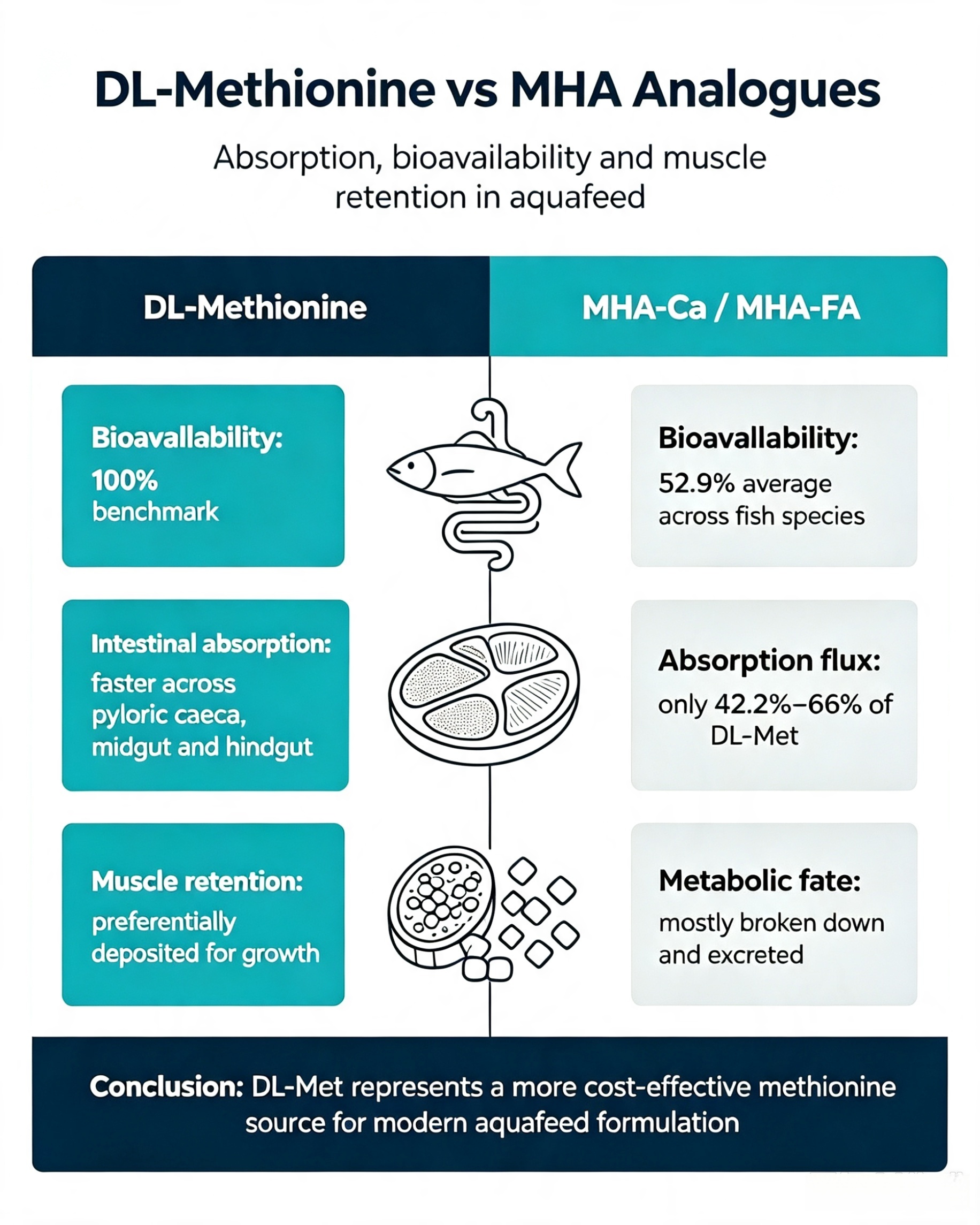
Methionine acts as a key limiting amino acid for aquatic species. Authoritative trial data demonstrates that DL‑Methionine surpasses methionine hydroxy analogues (MHA‑Ca / MHA‑FA) in terms of intestinal absorption and muscle nutrient retention.
Methionine acts as a key limiting amino acid for aquatic species. Authoritative trial data demonstrates that DL‑Methionine surpasses methionine hydroxy analogues (MHA‑Ca / MHA‑FA) in terms of intestinal absorption and muscle nutrient retention.
1. Lower Bioavailability of MHA (DL‑Met = 100 % Benchmark)
On a molar basis, MHA achieves only 75%‑80 % relative bioavailability versus DL‑Met.
When calculated on a product‑weight basis:
‑ Liquid MHA‑FA: 66.0 %‑70.4 %
‑ MHA‑Ca salt: 63.0 %‑67.2 %
Across multiple fish species, the average relative bioavailability of MHA stands at merely 52.9 %.
2. Faster Intestinal Absorption of DL‑Met
MHA’s maximum intestinal absorption flux reaches only 42.2 %‑66 % of that of DL‑Met. DL‑Met exhibits faster absorption across the pyloric caeca, midgut and hindgut segments.
3. Greater Muscle Deposition and Reduced Metabolic Waste
Isotope‑tracer studies indicate that DL‑Met is preferentially deposited in muscle tissue to support growth performance. By contrast, the majority of MHA undergoes metabolic breakdown and is excreted into the aquatic environment. Practical tilapia feeding trials confirm that DL‑Met supplementation yields higher body‑weight gain and improved feed conversion ratio.
Conclusion
Validated by peer‑reviewed multi‑species research, DL‑Methionine delivers rapid nutrient uptake and high‑level muscle retention. It represents a more cost‑effective methionine source for modern aquafeed formulation.